
No KYC Casinos on Mobile — Apps, Browsers & Performance
 Available in GB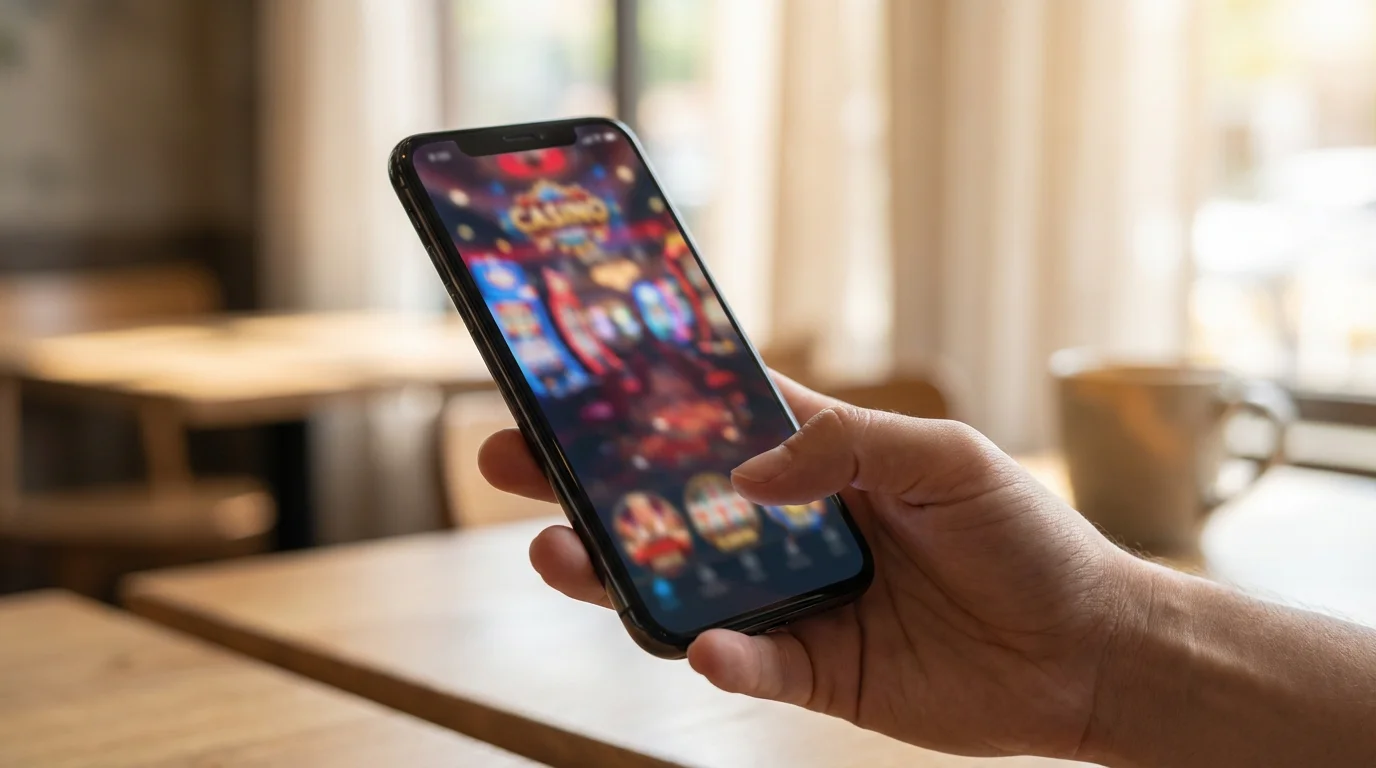
Mobile-First Design at Anonymous Casinos
The majority of traffic at no-KYC casinos now comes from mobile devices, and the platforms that have recognised this early have built their entire experience around the smaller screen. Mobile-first design is not the same thing as having a website that works on a phone. It means the interface, the navigation, the game loading architecture, and the payment flow were all conceived with a touchscreen as the primary input device. The desktop version is the adaptation, not the other way around.
The best no-KYC casinos in 2026 deliver a mobile experience that is virtually indistinguishable from a native app in terms of responsiveness and visual quality. Game lobbies load as scrollable grids optimised for thumb navigation. Search and category filters sit within easy reach. Deposit and withdrawal interfaces are streamlined to minimise the number of taps between deciding to transact and completing the action. Live dealer streams adapt to portrait orientation without cropping the essential elements of the table. Even the chat functions in live games have been redesigned for mobile keyboards rather than being awkward ports of desktop text inputs.
This design emphasis matters because the mobile context introduces constraints that desktop play does not. Screen real estate is limited, which means cluttered layouts and nested menus create genuine usability problems. Connection quality can fluctuate, particularly on mobile data, which means page weight and asset loading strategies need to be aggressive about performance. And the sessions themselves tend to be different — more frequent, shorter in duration, and more likely to be interrupted. A casino designed around these realities delivers a fundamentally better mobile experience than one that simply shrinks its desktop site to fit a smaller viewport.
Browser-Based Play vs Progressive Web Apps
No-KYC casinos do not offer native apps through the Apple App Store or Google Play Store. This is not a technical limitation — it is a policy one. Both Apple and Google prohibit real-money gambling apps from developers that do not hold gambling licences recognised by the platform’s review process, and Curaçao licences do not qualify. The result is that every no-KYC casino’s mobile experience is delivered through the browser or, increasingly, through a Progressive Web App that blurs the line between the two.
Browser-based play means opening the casino’s website in Safari, Chrome, or Firefox on your mobile device and playing directly. Modern mobile browsers are powerful enough to handle HTML5 casino games without any perceptible performance gap compared to a native app. Slots load in seconds, animations run smoothly, and the touchscreen interface responds to taps and swipes without lag. The experience is effectively instant — no download, no installation, no storage space consumed on your device. You bookmark the casino’s URL, open it when you want to play, and close the tab when you are done.
Progressive Web Apps take this a step further. A PWA is a website that can be “installed” on your home screen, where it behaves like a native app — it has its own icon, opens without the browser’s address bar visible, can send push notifications if you allow it, and may cache certain assets for faster loading. The casino prompts you to add it to your home screen, usually through a banner on your first or second visit. The technical advantage of a PWA over a simple bookmark is marginal for most users, but the psychological one is real: having the casino on your home screen, visually identical to any other app, makes the access feel native rather than web-based.
From a practical standpoint, the choice between browser play and a PWA makes little difference to game quality or performance. The underlying technology is identical. Where PWAs offer a slight edge is in session persistence — some PWAs maintain your login state more reliably between sessions than a browser tab does, reducing the frequency with which you need to re-enter credentials. For players who value the most streamlined access possible, installing the PWA is the better option. For players who prefer not to have a casino icon visible on their home screen — a valid concern for anyone who shares a device or values discretion — the browser approach leaves no visible trace beyond the browsing history.
Performance, Connectivity and Mobile Wallet Integration
Game performance on mobile depends on three variables: the device’s hardware, the connection quality, and the casino’s optimisation. Any smartphone released in the last three or four years has more than enough processing power to run HTML5 casino games smoothly — these are not graphically demanding applications. Slot animations, table game interfaces, and even live dealer video streams are well within the capability of mid-range Android devices and any current iPhone. Older or budget devices may experience occasional slowdowns during complex bonus rounds or when multiple animations trigger simultaneously, but outright incompatibility is rare.
Connection quality has a more noticeable impact, particularly for live dealer games. A stable Wi-Fi connection delivers the best experience, with consistent video quality and minimal latency between placing a bet and seeing the result. On mobile data, the experience depends on signal strength and network congestion. 4G connections are generally adequate for slots and RNG table games, which require only small data packets for each action. Live dealer streams consume more bandwidth — roughly 500 kilobytes to 1.5 megabytes per second depending on the quality setting — and can stutter or pixelate on a congested mobile network. 5G connections eliminate this concern entirely, delivering more than enough bandwidth for any casino content, but 5G coverage in the UK is still inconsistent outside major urban areas.
Mobile wallet integration is where the no-KYC mobile experience differs most from desktop. On a desktop browser, depositing with MetaMask or another browser extension wallet is a seamless process — the wallet extension is right there in the browser toolbar. On mobile, the integration is less straightforward. MetaMask has its own mobile app with a built-in browser, and using this to access the casino creates a smooth wallet-to-casino flow. Trust Wallet and Coinbase Wallet offer similar in-app browsers. However, if you access the casino through your device’s standard browser (Safari or Chrome), you will need to manually copy deposit addresses and switch between the browser and your wallet app to complete transactions. This is not difficult, but it introduces additional steps and the risk of copying an address incorrectly.
The platforms with the best mobile wallet integration have addressed this by implementing WalletConnect — a protocol that allows mobile wallets to communicate directly with web applications through QR codes or deep links. At a casino that supports WalletConnect, you can initiate a deposit from the casino’s mobile interface, your wallet app opens automatically with the transaction details pre-filled, and you confirm with a single tap. The funds arrive in your casino account without you having copied a single character. This is the standard the industry is moving toward, and platforms that support it offer a noticeably smoother mobile deposit experience than those that still rely on manual address copying.
The Casino in Your Pocket — No ID Required
The mobile no-KYC casino experience in 2026 represents a convergence of technologies that individually existed for years but have only recently matured together. Mobile-optimised casino platforms, browser-based game delivery, self-custodial crypto wallets on mobile, and stablecoin payment rails on low-fee networks combine to create something that was not possible even three or four years ago: a complete, anonymous gambling experience that fits in your pocket and can be accessed anywhere with an internet connection.
The implications of this accessibility cut in two directions. On the positive side, mobile play at no-KYC casinos is more convenient, more private, and more flexible than any previous form of online gambling. There is no application to download from a store that might track your installation. There is no document to upload from your phone’s camera roll. There is no bank transaction that labels itself as a gambling payment in your statement. The entire experience — from registration through gameplay to withdrawal — can happen on your phone during a lunch break, and when you close the browser, no trace remains unless you choose to keep one.
On the cautionary side, the same accessibility that makes mobile no-KYC gambling convenient also makes it easy to engage with impulsively. The phone is always there. The casino is always one tap away. There is no physical distance between you and the decision to deposit, no cooling-off period built into the process, no friction that might give a second thought time to form. For players with strong self-regulation habits, this is a non-issue. For anyone whose gambling discipline is still developing, the frictionless nature of mobile access at an anonymous platform is a factor that deserves honest acknowledgement.
The technology itself is neutral. A mobile no-KYC casino is a tool, and like any tool, its value depends on how it is used. Used thoughtfully — with a clear budget, a time limit, and the self-awareness to stop when either is reached — it offers a gambling experience that is fast, private, and genuinely enjoyable. Used without those guardrails, the same convenience becomes a liability. The phone does not care which category you fall into. That distinction is yours to make every time you open the browser.
Find more mobile guides at nokyccasinos-uk. Also see our no-KYC casinos guide.