
Crash Games at Anonymous Casinos — Rules, Strategy & Sites
 Available in GB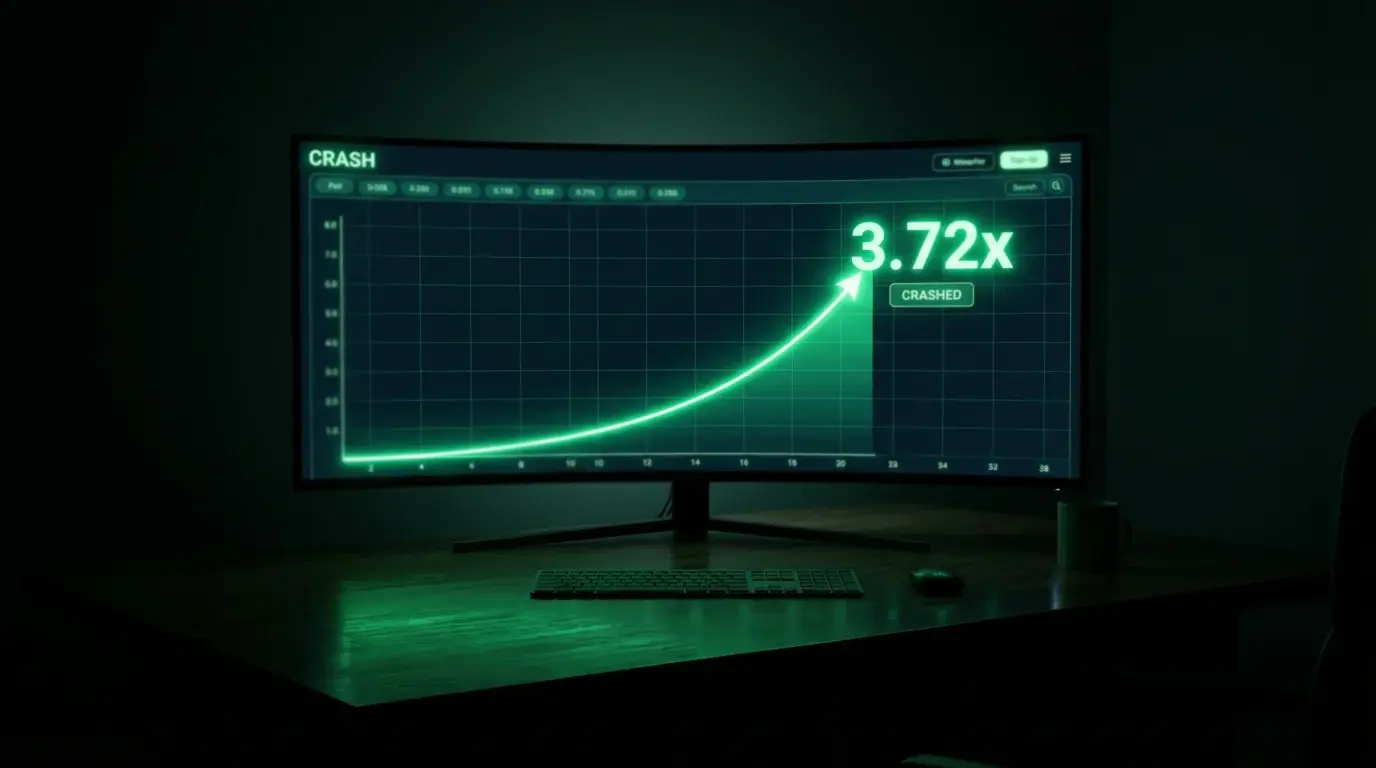
What Crash Games Are and How They Work
Crash is the game that crypto casinos invented for themselves. Unlike slots or table games that were adapted from the traditional gambling world and ported into a digital format, crash was born on blockchain platforms and designed around the speed, simplicity, and provably fair mechanics that define the crypto casino experience. It is the signature game type of the no-KYC market, and for many players it is the reason they visit these platforms in the first place.
The mechanics are stripped to their essence. A round begins with a multiplier that starts at 1.00x and rises continuously — 1.10x, 1.50x, 2.00x, 3.00x, and beyond. The multiplier can climb to any height: 10x, 100x, theoretically infinite. At some unpredictable point, the round crashes — the multiplier drops to zero and the round ends. Your task is to cash out before the crash. If you cash out at 2.50x, your stake is multiplied by 2.50. If the round crashes before you cash out, you lose your stake entirely. That is the complete rule set. There are no bonus rounds, no free spins, no progressive jackpots. There is just the multiplier, the crash point, and the decision of when to take your money off the table.
The crash point for each round is determined by a provably fair algorithm. Before the round begins, the server generates a seed that determines the exact multiplier at which the round will crash. This seed is hashed and the hash is shared with players before bets are placed, ensuring the casino cannot alter the outcome after seeing the bets. Once the round concludes, the original seed is revealed and any player can verify that the crash point was determined before the round started. The mathematics that make this trustless system work are identical to the provably fair mechanics used across other crypto casino originals — cryptographic commitment followed by transparent verification.
Most crash games allow you to set an automatic cashout multiplier before the round begins. If you set auto-cashout at 2.00x, the system will cash you out the instant the multiplier reaches that level, removing the need for manual timing. This feature is particularly useful for players who want to execute a consistent strategy without the emotional interference of watching the multiplier climb past their target.
Strategy, Variance and the Psychology of the Multiplier
Crash is a negative-expectation game. The house edge — typically between 1% and 4% depending on the platform — is built into the algorithm that generates crash points, and no strategy can overcome it over an infinite number of rounds. What strategy can do is manage variance: the size and frequency of swings around the expected outcome. Different approaches produce different variance profiles, and choosing the right one depends on your bankroll, your risk tolerance, and what you are trying to get out of the game.
The conservative approach targets low multipliers — cashing out at 1.10x to 1.50x on every round. At these levels, the crash point exceeds your target in the vast majority of rounds, producing a high win rate with small, steady profits. The risk is that the occasional early crash — a round that busts at 1.02x or even 1.00x — wipes out several rounds of accumulated gains. This strategy has low variance and is psychologically comfortable, because winning most rounds feels good even when the individual wins are small. It is also the least exciting way to play crash, which is why many players who start with this approach eventually drift toward higher targets.
The aggressive approach targets high multipliers — 5x, 10x, 20x, or beyond. These cashout points hit less frequently, producing long losing streaks punctuated by substantial wins. The variance is high, the emotional experience is intense, and the bankroll requirements are significant because you need to survive the dry spells between hits. Mathematically, the expected value is identical to the conservative approach — the house edge applies regardless of your target — but the experience is dramatically different. High-target play is the version of crash that generates the stories, the screenshots, and the social media clips of 1000x cashouts. It is also the version that depletes bankrolls most rapidly for players who underestimate the length of the losing streaks.
The psychology of the multiplier is where crash becomes uniquely compelling and uniquely dangerous. Watching the number climb past your target after you have already cashed out triggers regret. Watching it crash just below your target triggers frustration. The game is designed — not maliciously, but structurally — to produce these emotions on a repeating loop, and the emotional cycle encourages impulsive adjustments: raising your target after seeing high multipliers, lowering it after a string of early crashes. The players who perform best at crash over time are those who set a target, commit to it, and resist the urge to chase the multiplier up or down in response to recent outcomes.
Best Crash Game Platforms at No KYC Casinos
Crash games are available at the majority of no-KYC casinos that feature in-house originals, but the quality and implementation vary meaningfully between platforms. The differences show up in the house edge, the provably fair implementation, the interface design, and the social features that have become a defining part of the crash experience.
The house edge is the first thing to check. Some platforms publish it transparently in the game’s information panel. Others require you to calculate it from the provably fair algorithm documentation or to simply trust the platform’s claims. A crash game with a 1% house edge is a significantly better proposition than one with a 4% edge, and over thousands of rounds the difference compounds into a material impact on your bankroll. If the casino does not disclose the house edge for its crash game, treat that opacity as a negative signal.
Interface design matters more in crash than in most casino games because the core experience is visual and time-sensitive. A well-designed crash interface shows the multiplier clearly, displays the bet history and crash points from recent rounds, provides an intuitive auto-cashout input, and — crucially — does not lag or stutter during the rising phase. A fraction of a second of latency between clicking the cashout button and the system registering the action can be the difference between cashing out at 2.00x and losing your stake to a 1.98x crash. The best platforms invest in low-latency frontend infrastructure that makes manual cashout responsive and reliable.
Social features have become a signature element of the crash experience. Most implementations display a real-time feed of other players’ bets and cashouts alongside the multiplier, creating a shared experience where you can see who bailed early, who is still riding, and who got caught in the crash. Some platforms add a chat function where players react in real time. These social elements have no bearing on the mathematical outcome, but they add an atmosphere that transforms crash from a solitary number-watching exercise into something closer to a communal event. For players who value this social dimension, the quality of the implementation — how many concurrent players are visible, how responsive the chat is, whether the interface handles high-traffic rounds without degrading — is a legitimate selection criterion.
The Crash Curve — When to Walk Away
Crash is the easiest casino game to understand and one of the hardest to stop playing. The rounds are short — ten seconds, sometimes less — which means the feedback loop between bet, outcome, and next bet is tighter than in any other game format. There is no dealing animation, no wheel spin, no reel cascade. Just a number that rises, a decision point, and an immediate result. The speed makes sessions compress: what feels like fifteen minutes can easily be forty-five, and the cumulative wagering over a rapid-fire session can exceed what a player expected to spend by a wide margin.
Session discipline matters more in crash than in slower-paced games. The combination of fast rounds, high emotional engagement, and the visible-but-unreachable promise of massive multipliers creates a playing environment that actively works against the intention to stop. Setting a hard session limit — either by time or by number of rounds — before you begin, and using the auto-cashout feature to enforce consistency, are the two most effective structural defences against the drift that crash encourages.
The bankroll management principle is the same as for any casino game: decide what you can afford to lose before you sit down, and do not exceed it. The difference with crash is that the pace of the game can consume a bankroll faster than most players anticipate. A hundred rounds at two dollars per round — entirely plausible in a fifteen-minute session — represents two hundred dollars of wagering. At a 3% house edge, the expected cost of that session is six dollars, but the actual outcome can vary enormously. A few early crashes on rounds where you were targeting a high multiplier, and the bankroll can be gone before the mathematical average has any chance to assert itself.
Walk away when you have reached your limit. Walk away when the multiplier is controlling your emotions rather than the other way around. Walk away when you are chasing a specific number because you “feel” it is due. The crash curve does not care about your feelings, your streak, or your plan. It is a cryptographic function that produces random outcomes within a defined distribution. Treating it with that level of detachment — while still enjoying the ride — is what separates players who have a good time from those who have a bad morning.