
UKGC vs Offshore
 Available in GB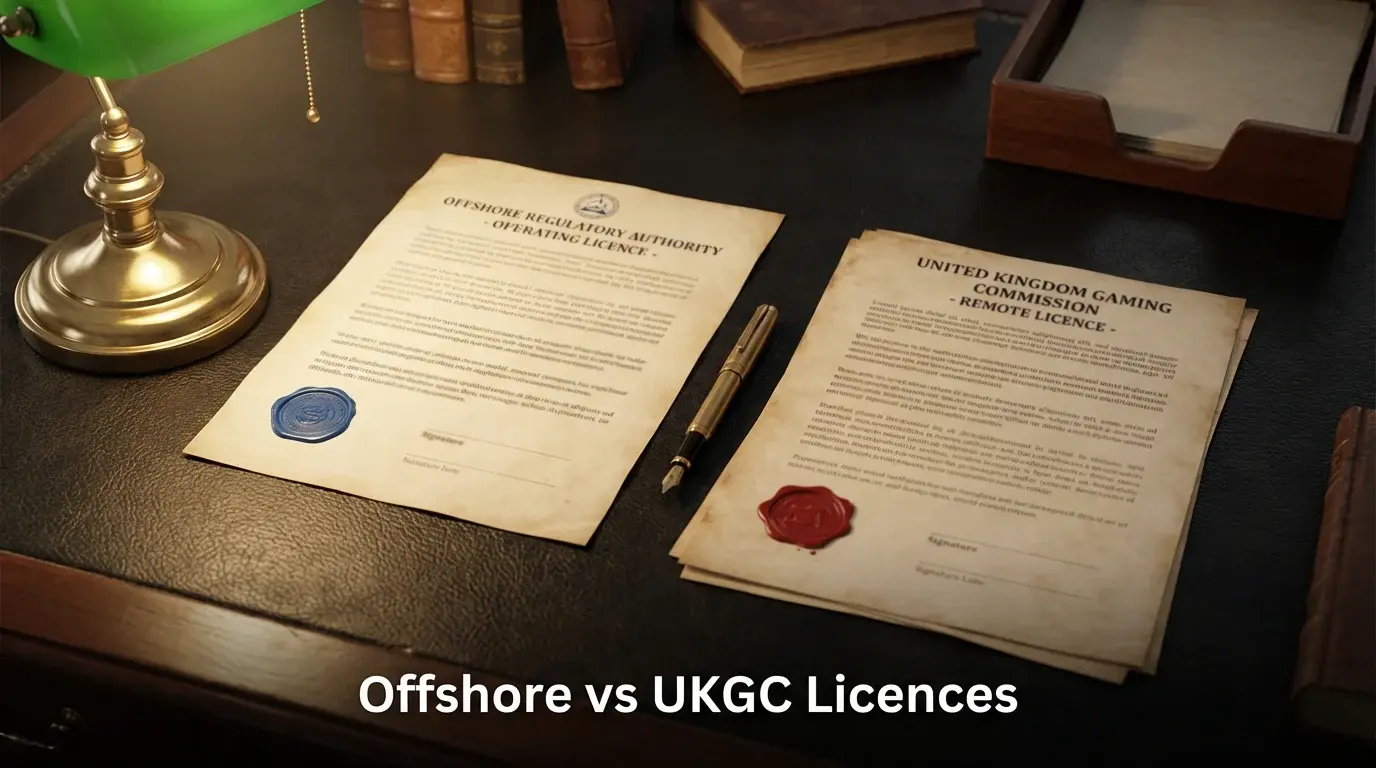
Two Licensing Worlds — and UK Players Caught Between Them
The UKGC writes the rules. Offshore jurisdictions write different ones. UK players choose which to follow. That choice — whether to play at a domestically licensed casino or an offshore platform operating under a Curaçao, Anjouan, or Costa Rica licence — is the single most consequential decision in the no-KYC gambling landscape. Everything else flows from it: the verification requirements you face, the protections you can rely on, the recourse available when things go wrong, and the legal framework your activity sits within.
The UK Gambling Commission runs one of the most tightly regulated gambling markets on the planet. Operators holding a UKGC licence are bound by mandatory identity verification, affordability checks, advertising restrictions, responsible gambling obligations, and a formal dispute resolution process backed by independent adjudicators. It’s a framework built over two decades of legislative refinement, and it leaves very little room for anonymity. That’s the point — the system prioritises consumer protection over convenience, and it does so aggressively.
Offshore licensing operates on fundamentally different assumptions. Jurisdictions like Curaçao don’t impose KYC mandates on every player interaction. They don’t require GamStop integration. They don’t enforce deposit affordability checks. The regulatory burden is lighter, the oversight less granular, and the cost of entry for operators dramatically lower. This is what makes no-KYC casinos possible — and it’s also what makes them riskier. The two licensing worlds aren’t slightly different versions of the same thing. They’re different systems, with different priorities, serving the same group of players.
For UK players navigating between these systems, understanding what each licence actually guarantees — and what it doesn’t — is not optional. It’s the baseline for making informed decisions about where to deposit, what protections exist, and what you’re giving up in exchange for speed and privacy.
How UKGC Licensing Works
The UKGC is one of the strictest gambling regulators in the world — by design. Established under the Gambling Act 2005, the UK Gambling Commission oversees every aspect of legal gambling in Great Britain, from the licensing of operators to the enforcement of player protection standards. Any casino, sportsbook, or gaming platform that wants to legally offer services to UK residents must hold an active UKGC licence, and obtaining one is neither cheap nor simple.
The application process requires operators to demonstrate financial stability, technical security, fair gaming practices, and comprehensive responsible gambling policies. Once licensed, operators are subject to ongoing compliance reviews, and the UKGC retains the authority to impose fines, suspend licences, or revoke them entirely for regulatory breaches. The fines are not trivial — UKGC penalty packages regularly reach millions of pounds, and the reputational damage of a public enforcement action can be equally costly. This creates a regulatory environment where compliance is taken seriously, because the consequences of non-compliance are severe.
Mandatory KYC and Affordability Checks
Every UKGC-licensed operator must verify the identity of every customer before allowing withdrawals, and in most cases, before the first deposit clears. The KYC process typically involves providing a government-issued photo ID (passport or driving licence), proof of address (utility bill or bank statement dated within three months), and sometimes proof of funds for higher-value accounts. The operator must confirm the player’s age, identity, and address before the account is fully activated for financial transactions.
Beyond basic identity verification, UKGC licensees are required to conduct affordability assessments. These checks aim to identify players who may be spending beyond their means — a responsible gambling measure designed to prevent financial harm. In practice, affordability checks can trigger when a player’s deposits exceed certain thresholds, prompting the operator to request evidence of income such as payslips, bank statements, or tax returns. The thresholds and implementation vary by operator, but the regulatory expectation is clear: if there are signs a player cannot afford their gambling activity, the operator must intervene.
For players, these requirements create a heavily documented gambling experience. Your name, address, date of birth, photo ID, and potentially your income are all stored on the operator’s servers. The system provides strong protections against underage gambling and problem gambling, but it also means your gambling activity is permanently tied to your real-world identity in a way that no opt-out mechanism can undo.
Financial Vulnerability Checks and October 2025 Regulatory Expansion
The UKGC’s tightening of the verification framework has been a phased process. In August 2024, the Commission introduced financial vulnerability checks triggered when a customer’s net deposits exceeded £500 within a rolling 30-day period. From 28 February 2025, that threshold was lowered to £150 in net deposits per 30-day rolling period — broadening the scope significantly. Separately, the October 2025 regulatory update required all licensed operators to prompt new customers to set a financial limit before their first deposit, made limit-setting tools more accessible on homepages and deposit pages, and mandated six-monthly reminders for players to review their account activity and spending.
The practical effect for players is more friction at lower spending levels. With the February 2025 threshold set at just £150 in net deposits per month, many recreational players now encounter financial vulnerability checks that would previously have been reserved for higher-spending accounts. For some UK players, this tightening was the catalyst that pushed them toward offshore platforms where these checks simply don’t exist. The timing of the regulatory expansion and the growth in UK traffic to no-KYC casinos is not coincidental.
Offshore Licences: Curaçao, Anjouan, Costa Rica
Curaçao issues more crypto casino licences than any other jurisdiction on earth. That statistic alone explains why the overwhelming majority of no-KYC casinos carry a Curaçao eGaming licence — or, increasingly, a licence from Anjouan or operate under the loosely regulated umbrella of Costa Rica. These jurisdictions don’t compete with the UKGC on player protection standards. They compete on accessibility, cost, and the operational freedom they grant to operators. For casino businesses built around crypto payments and minimal verification, offshore licensing provides the legal framework that makes the model viable.
Curaçao eGaming Licence
The Curaçao eGaming licence has been the backbone of the offshore gambling industry for over two decades. Issued under the authority of the Government of Curaçao, the licence permits operators to offer casino games, sports betting, and lottery products to players worldwide — with the notable exception of jurisdictions that explicitly block offshore gambling, which the UK technically does at the operator level but not at the player level.
Curaçao’s licensing framework underwent a significant overhaul with the introduction of the National Ordinance on Games of Chance (LOK), which was enacted on 17 December 2024 and came into force on 24 December 2024, replacing the older National Ordinance on Offshore Games of Hazard (NOOGH) and its master-sublicence structure with a direct licensing model. The reform process began in late 2023, when the Curaçao Gaming Authority started accepting direct licence applications. Under the new framework, each operator must hold its own licence and meet updated requirements for player fund segregation, responsible gambling tools, and AML compliance. The changes were designed to address longstanding criticism that Curaçao licences offered little more than a rubber stamp, and while the new requirements are more demanding than the old system, they remain substantially lighter than UKGC standards.
In practical terms, a Curaçao licence means the casino is obligated to maintain fair gaming standards (typically demonstrated through RNG certification from testing labs like iTech Labs or GLI), implement basic AML procedures, and provide some form of player complaint mechanism. What it does not require is universal KYC verification, affordability checks, deposit limits, GamStop integration, or access to independent dispute adjudication. The gap between the Curaçao standard and the UKGC standard is wide, and players should understand exactly where the floor is set.
Anjouan Licence
Anjouan — an island in the Comoros archipelago off the east coast of Africa — has emerged as a licensing jurisdiction for crypto casinos over the past few years. The Anjouan Gaming Licence, issued by the Anjouan Corporate Services Authority, offers a low-cost, fast-turnaround licensing option that appeals to new operators and platforms looking for a regulatory footprint without Curaçao’s increasingly structured requirements.
The Anjouan licensing framework is lighter than Curaçao’s post-2023 model. Application processing is faster, fees are lower, and the ongoing compliance obligations are less demanding. For operators, this makes Anjouan an attractive entry point. For players, it means even fewer guaranteed protections. There’s no established track record of enforcement, limited transparency about the licensing body’s oversight capacity, and minimal public information about how player complaints are handled — if they’re handled at all.
An Anjouan licence is not inherently a red flag, but it does mean players should apply more scrutiny to the platform’s own practices — security measures, withdrawal reliability, community reputation — because the licence itself provides a thinner safety layer than even Curaçao’s framework.
Other Offshore Jurisdictions
Costa Rica occupies an unusual position in the offshore gambling landscape. The country doesn’t technically issue gambling licences. Instead, casino operators register as data processing companies under Costa Rican corporate law, which provides a legal basis for operating gaming platforms without a dedicated gambling regulatory framework. This means there is no licensing authority overseeing fair play, no mandated player protections, and no formal complaint process. A casino “licensed in Costa Rica” is really a company incorporated in Costa Rica — a meaningful distinction.
Other jurisdictions appear occasionally in the no-KYC casino space. Panama, Kahnawake (a Mohawk territory in Canada), and Gibraltar each have licensing frameworks of varying stringency, though Gibraltar’s standards approach UKGC levels and its licensees generally operate with full KYC. The Isle of Man and Malta (MGA) are sometimes mentioned in broader gambling licensing discussions, but both impose verification requirements that make them incompatible with the no-KYC model. For the purposes of anonymous gambling, Curaçao and Anjouan dominate, with a smaller segment operating under Costa Rica’s non-licensing framework.
Side-by-Side: UKGC vs Offshore Player Protections
Protection isn’t binary — it’s a spectrum, and the gap is wider than most players realise. When you compare what a UKGC licence guarantees versus what a Curaçao or Anjouan licence offers, the differences aren’t marginal adjustments. They’re structural divergences in how the player-operator relationship is governed, monitored, and enforced.
Under a UKGC licence, player funds must be segregated from operational funds, meaning if the casino goes bankrupt, player balances are ring-fenced and recoverable. Offshore jurisdictions generally require some form of fund protection, but the enforcement mechanisms are weaker, the auditing is less frequent, and the practical recourse for players in a bankruptcy scenario is far less certain. At a Curaçao-licensed casino, fund segregation exists as a regulatory expectation. At a UKGC casino, it exists as an enforced legal obligation with established precedent.
Dispute resolution illustrates the gap most clearly. UKGC licensees must participate in alternative dispute resolution through approved bodies — IBAS and eCOGRA being the most recognised. If a player believes a casino has acted unfairly — withheld a withdrawal, applied bonus terms retroactively, or closed an account without cause — there’s a formal, independent process for adjudication. The casino is legally required to cooperate, and ADR decisions carry weight. Offshore casinos may offer their own internal complaint processes, and some Curaçao licensees participate in voluntary mediation services, but there is no equivalent to IBAS. If the casino’s internal team decides against you, your options narrow to public complaint forums and hope.
Self-exclusion is another area of significant divergence. UKGC casinos are integrated with GamStop, the national self-exclusion scheme that allows players to block themselves from all licensed UK gambling sites simultaneously. Offshore casinos operate entirely outside this network. A player who has self-excluded via GamStop can sign up at a Curaçao-licensed no-KYC casino within minutes, with no mechanism to prevent it. Whether this represents freedom of choice or a dangerous gap in player protection depends on perspective — but the absence of the safety net is a fact.
Game fairness standards also differ in enforcement rigour. Both UKGC and Curaçao-licensed casinos are expected to use certified random number generators, and reputable platforms in both systems use testing labs like GLI, iTech Labs, or BMM Testlabs. The difference is the frequency and depth of auditing. UKGC operators face regular compliance reviews that include technical audits of game fairness. Offshore operators may undergo initial certification but face less rigorous ongoing scrutiny. For players at well-established offshore casinos using tier-one game providers like Evolution or Pragmatic Play, the practical fairness risk is low. At smaller platforms running proprietary games, the assurance is thinner.
The Legal Grey Area for UK Players
The Gambling Act targets operators, not the punter clicking “deposit.” This is the central legal reality that enables UK players to use offshore no-KYC casinos without facing criminal liability, while simultaneously making those casinos technically illegal to operate for the UK market. The asymmetry is deliberate: UK gambling law was designed to regulate the supply side — the companies offering gambling services — rather than prosecuting individual consumers for accessing them.
Under the Gambling Act 2005, it is an offence for an operator to provide gambling services to British consumers without a UKGC licence. The Act does not, however, criminalise the act of a UK resident placing a bet or playing a casino game at an unlicensed offshore platform. There is no provision in UK law that makes it illegal for a player to deposit at a Curaçao-licensed casino, play blackjack, and withdraw winnings. The player hasn’t committed an offence. The casino has — but enforcement against offshore operators registered in foreign jurisdictions is a separate challenge entirely.
This creates the grey area that the no-KYC casino market exists within. Players are not breaking the law, but they’re operating outside the legal protections that UK law was designed to provide. The UKGC has no jurisdiction over Curaçao-licensed operators, which means it cannot investigate complaints, impose fines, or require operators to return withheld funds. The player’s legal position is technically clean, but their practical position is exposed. You’re not committing an offence by playing at an offshore casino. You’re also not covered by the framework that was built to protect you if that casino acts unfairly.
UKGC enforcement efforts focus on restricting access rather than punishing players. The Commission works with internet service providers to block domains of unlicensed operators targeting UK customers, and it has issued warnings to payment processors about facilitating transactions with unlicensed gambling sites. These measures create friction — some offshore casino domains are periodically blocked for UK IP addresses — but they don’t constitute a prohibition on player activity. Players using VPNs or accessing domains not yet blocked continue to reach offshore platforms without legal consequence.
The tax position adds another layer. Gambling winnings in the UK are not subject to income tax or capital gains tax for recreational players, regardless of whether the casino is UKGC-licensed or offshore. HMRC’s position is that betting and gaming winnings are not taxable for the person placing the bet. This applies equally to winnings at a UKGC casino paid in pounds and to crypto winnings at an offshore casino — though the conversion from crypto to fiat may create separate capital gains tax considerations if the crypto itself has appreciated in value between acquisition and disposal. The legal grey area, in other words, is specifically about player protection and regulatory coverage, not about tax liability or criminal exposure.
What Happens When Something Goes Wrong
At a UKGC casino, you escalate to IBAS. At an offshore casino, you escalate to… customer service. That difference might sound minor until you’re sitting on a frozen withdrawal with no explanation and no independent party to appeal to. The dispute resolution gap between licensed and offshore gambling is arguably the most significant practical consequence of choosing a no-KYC platform, because it only becomes visible at the worst possible moment.
The most common dispute scenarios at online casinos are consistent across both systems: delayed or refused withdrawals, bonus terms applied in ways the player didn’t expect, account closures with balance confiscation, and disagreements over game outcomes. At a UKGC casino, these disputes follow a defined escalation path. You first contact the operator’s internal complaints team, which has eight weeks to resolve the issue. If unresolved, you can escalate to an approved ADR provider like IBAS or eCOGRA, whose decision is binding on the operator. If the operator fails to comply, the UKGC can intervene directly. The system isn’t perfect — ADR decisions can take weeks, and outcomes aren’t always favourable — but the process exists, it’s independent, and the casino is legally obligated to participate.
At an offshore casino, the escalation path typically ends at the operator’s customer support team. Some Curaçao-licensed casinos participate in voluntary complaint mediation through services like AskGamblers or Casinomeister, where community reputation and public pressure create an incentive to resolve disputes. These platforms have resolved thousands of player complaints and carry genuine influence in the industry. But participation is voluntary, outcomes are not legally binding, and casinos that choose to ignore complaints face no regulatory sanction beyond reputational damage.
For disputes involving significant sums — a five-figure withdrawal refused, for example — the absence of independent adjudication becomes acutely felt. Legal action against an offshore operator registered in Curaçao or Anjouan is theoretically possible but practically prohibitive. The cost of cross-jurisdictional litigation, the difficulty of enforcing a foreign judgment, and the anonymity of many offshore corporate structures combine to make this a non-viable option for most individual players. The realistic outcome in a major dispute with an uncooperative offshore casino is that the player absorbs the loss. Knowing this before depositing is part of the informed risk assessment that no-KYC gambling requires.
Licence Labels vs Real-World Protection
A licence tells you where the casino answers to — not whether it’ll answer to you. That distinction is the thread running through every section of this comparison. A UKGC licence means an operator is subject to one of the world’s most demanding regulatory frameworks, with enforceable player protections, independent dispute resolution, and real financial consequences for non-compliance. A Curaçao or Anjouan licence means an operator has met a set of requirements that are significantly less demanding, in a jurisdiction with less enforcement capacity and less transparency about how that capacity is exercised.
Neither licence type tells the full story about a specific casino’s reliability. There are UKGC-licensed operators that have paid millions in fines for failing players, and there are Curaçao-licensed platforms with years of clean operation and strong community reputations. The licence is a starting point for assessment, not the final word. But as a structural matter, the protections available under the UKGC framework are categorically stronger than anything the offshore licensing world currently provides.
For UK players considering no-KYC casinos, the question isn’t whether offshore licensing is “good enough.” It’s whether the trade-off — less regulatory protection in exchange for privacy, speed, and freedom from affordability checks — aligns with your risk tolerance and your gambling behaviour. Players who deposit modest amounts, withdraw regularly, and treat offshore casinos as entertainment platforms may find the trade-off entirely acceptable. Players who deposit significant sums or expect recourse when problems arise should understand that the safety net they’re used to doesn’t extend beyond UKGC borders. The licence on the casino’s footer is information. What you do with that information is the decision that matters.
Stay informed at nokyccasinos-uk. Also read our Curacao licensed casinos UK guide.